- August 18th, 2026
- 8 min read
A business plan helps you make decisions about what you’re building, who you serve, how the business will make money, how you’ll attract clients, what needs to happen operationally and what resources you may need to grow. Depending on where you are in business, that could mean creating a startup plan, growth plan, funding plan or operational plan.
But creating a business plan can reveal something else too: the decisions, assumptions and fears influencing how you build the business.
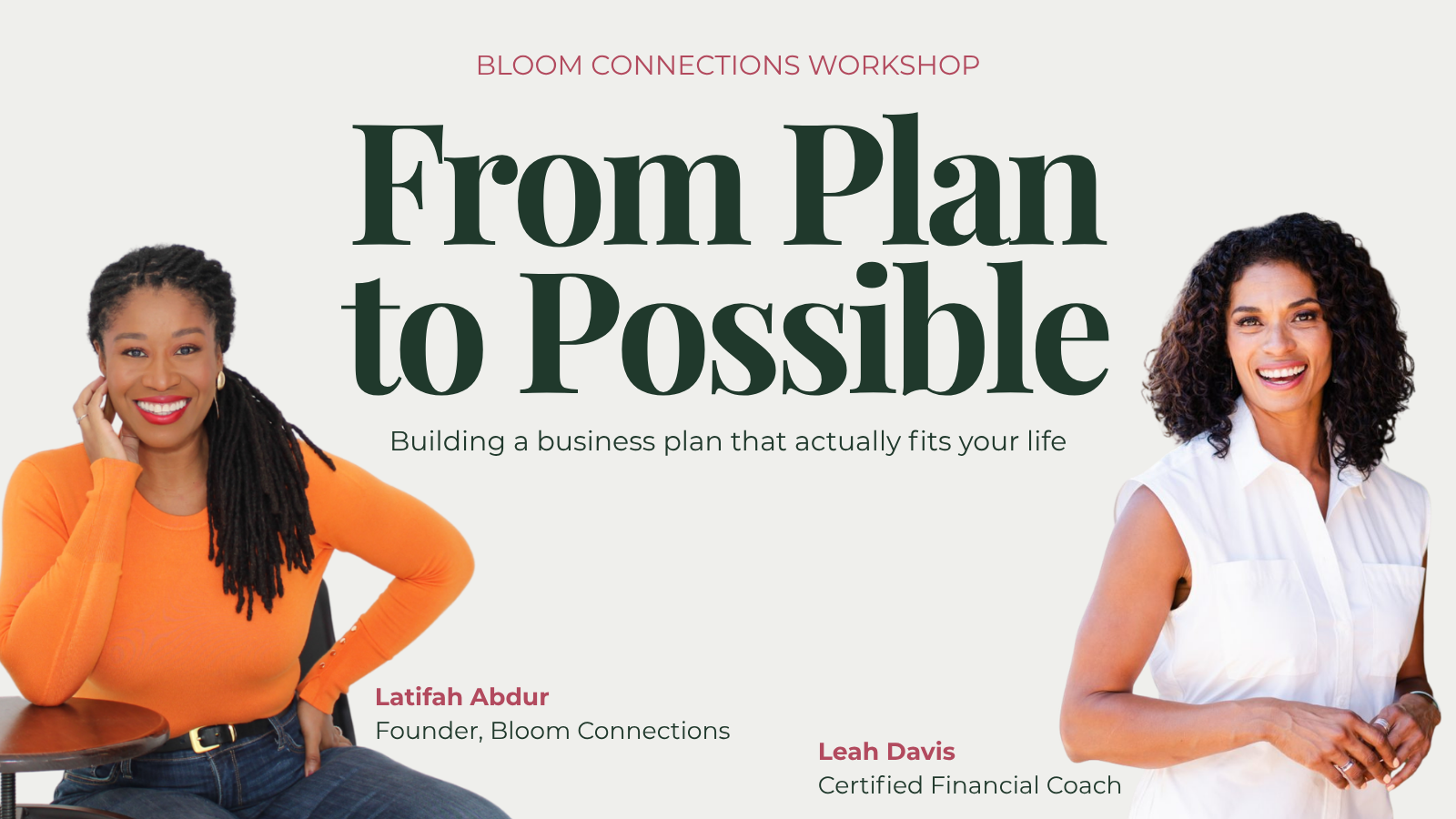
That became clear during From Plan to Possible: Building a Business Plan That Actually Fits Your Life, a Bloom Connections workshop co-led by Latifah Abdur, founder of Bloom Connections and marketing strategist, and Leah Davis, certified financial coach and founder of Leah Davis Coaching.
One woman realized she had been planning events before fully defining the business behind them. For someone else, the questions exposed how much the day-to-day management of her business was weighing on her. A revenue question prompted one participant to write down a number that left her feeling both “scared” and “empowered.” When the conversation turned to sales, a woman with plenty of prospective clients admitted she was struggling to convert them.
The business plan was doing more than documenting their businesses. It was bringing decisions to the surface. Latifah was listening for what those answers revealed about the business, while Leah was helping the women notice what was happening underneath those decisions. Both mattered.
Why business planning was the starting point
Before the workshop, Bloom asked women where they needed support. The strongest response was attracting and converting clients. Others wanted help creating a plan for growth, structuring their businesses or deciding next steps, and defining their business direction or offers.
Women also named fear and avoidance around money, pricing and selling, confidence with money, and developing a healthier relationship with earning and receiving. At first glance, those can look like separate problems. One sounds strategic, while the other sounds personal. In business, however, they can show up in the same decision.
You can know you need more clients and still struggle with the activities required to close them. Recognizing that your pricing needs to change doesn’t necessarily make it easier to say the number. Growth can be the goal while the business still depends on you doing almost everything.
That was part of the reason Latifah and Leah were in the room together. The workshop wasn’t going to separate the business from the woman making the business decisions.
Four plans, because not every business needs the same thing
Not everyone entered the workshop trying to solve the same problem. Some women were still defining the foundation of what they were building. Existing business owners were thinking about growth. Funding had become the next question for some, while others had a clear vision but needed stronger operations underneath it.
Participants could choose one of four business-planning paths.
- Startup planning focused on turning an idea into a more defined business, including the customer, problem, offer and revenue model.
- Growth planning focused on what an existing business would need to reach its next stage.
- Funding planning prompted women to think about how much capital they might need, what it would support and what they would need to prepare before pursuing funding opportunities.
- Operational planning focused on how the business actually works, including systems, processes, responsibilities, resources and capacity.
Women chose the plan that matched the decisions in front of them, and then they got to work. Latifah played music and gave the room time to answer the questions rather than filling the workshop with another presentation about how to write a business plan. As they worked, Leah gave them a different instruction: Notice what you’re noticing.
Where did you hesitate? Which questions were easy? What did you want to skip? What did a question make you realize? Those observations became the conversation when everyone came back together.
What the business planning questions started to reveal
Finishing the plan wasn’t what stood out to one participant. What stayed with her was what the questions had shown her along the way.
“There are things that I now realize I need to, like, really go back and kind of hone in and work on.”
Business planning can be useful even when you’ve already been operating a business because a lot can feel settled when it stays in your head. You may believe you know your customer, understand how the business makes money, know where you’re going and have a sense of what needs to happen next.
Then a planning question asks you to be specific. Who exactly are you serving? What are you selling? How does the business generate revenue? What does growth mean for this business? How will you attract and convert clients? What resources will growth require?
Something you thought was decided can reveal itself as an assumption. The discovery doesn’t mean the plan failed. It means the plan is doing its job. A useful business plan doesn’t only document answers. It can expose the question you actually need to answer next.
When the business plan makes you zoom out
For one woman, the questions changed the altitude of her thinking. She had been concentrating on events she wanted to create. Because the events were tangible, she could imagine them, plan them and think about what she wanted people to experience.
Working through the plan made her realize those events belonged underneath something larger. She needed to define the organization behind them. Her takeaway was simple:
“Don’t try to boil the ocean.”
It’s easy to build whatever is immediately in front of you, whether that’s a workshop, website, new service, event or offer you want to launch next month. Those are still activities inside a business. At some point, someone has to zoom out and ask: What are we actually building?
How do these pieces fit together? Which opportunities belong? Which ones are simply things we could do? What does the larger business need to become? In this case, the plan wasn’t telling her to add more. It was helping her see what needed to come first.
A business vision still needs the operations to support it
The operational plan surfaced a different challenge. Vision wasn’t the problem for the woman working through it. Turning that vision into something she could actually run was harder.
As she answered the questions, she started thinking about how the different pieces would function and where she could streamline the business. Then she noticed what the day-to-day was doing to her.
“I think that’s where, like, some of my anxiety actually comes up, is just like the day-to-day, like, management of my business.”
She wasn’t uncertain about the vision. She was feeling what it took to hold it. The problem, then, wasn’t deciding what she wanted to create. It was determining what the business required to support it.
Eventually, the question has to move from What could this become? to What has to be true for this to actually work? A process may need to change. Automation could remove work that no longer needs to be done manually. Bringing in another person may become necessary. Capacity might need attention before another round of marketing brings more business through the door.
Latifah recognized some of that tension in herself:
“I’m someone who has so many ideas and I have to make sure that they all come together eventually.”
For a founder with a lot of ideas, planning can help separate what is possible from what actually belongs in the business now. Growth isn’t only deciding what you want more of. It’s deciding what has to change if more actually arrives.
Then someone wrote down a number that scared her
The conversation shifted when the planning exercise reached money. A participant who had intended to work on growth returned to the startup questions after realizing she had never truly sat down and created a business plan.
When she reached the financial section, something changed.
“It also felt like therapy because I felt scared, but also empowered to write down like a big audacious number that I wouldn’t normally have written down.”
The question had asked for a number. The number brought a story with it.
As she talked about the experience, she connected some of her discomfort to messages about money she had grown up around and feelings about asking for what her work was worth. By the end of her reflection, she described the exercise as “very therapeutic.” This was exactly the kind of response Leah had asked the room to notice.
A revenue goal looks mathematical, and part of it is. You can work backward from pricing, customers, conversion rates, expenses and capacity. Yet another conversation may be happening while you’re doing the math. You might wonder whether the number is too high, whether you can really make that much, who would pay you at that level or whether you need to make the goal more “realistic.”
Funding brought the same tension into a more concrete business decision. One participant, ready to “get to the money,” had to think about how much funding the business actually needed, what the capital would support and what she would need to prepare before pursuing it. She also raised something the planning template hadn’t asked: women, and Black women in particular, don’t always have open conversations about money.
Leah picked up on the observation. For some women, talking openly about financial uncertainty can feel particularly vulnerable when they’re accustomed to being the person other people depend on. Those experiences don’t disappear when someone becomes a business owner. They can walk into the business with us.
None of this means financial decisions become exercises in feelings. Revenue goals still need math. Funding decisions still require numbers. Pricing still has to make sense for the business. What the conversation revealed was the importance of distinguishing between what the evidence is telling you and how you feel about what the evidence is telling you.
A useful question becomes: Is the business evidence changing the number, or is my discomfort with the number changing it?
The business decision and what may be influencing it
By this point, the reason for bringing Latifah’s and Leah’s perspectives together had become much clearer. Latifah was listening for what the answers revealed about the business, whether that was an undefined structure, an operational bottleneck, a need for funding or a point where delegation might become necessary.
Leah was listening for something underneath those answers: What was happening inside the woman making the decision?
The two weren’t competing explanations. A woman could need a funding strategy and notice that writing down the amount she wanted made her uncomfortable. Stronger operations could be necessary while asking someone else for help still felt difficult. The numbers might support different pricing while saying the new price brought up something entirely separate.
Leah explained:
“We can have the systems in place… and then also be able to focus on what we can do so that we can work on ourselves to be able to better propel our businesses forward.”
What a business plan can't do for you
Once the conversation reached that distinction, it naturally returned to action.
Latifah connected Leah’s point to something she had experienced in her own business: delegation.
There are times when there genuinely isn’t enough cash to hire support, and bootstrapping is the practical decision. Doing everything yourself, however, can become a habit that continues even after the business starts requiring something different.
Latifah included herself in that conversation:
“I’m so guilty, but I’ve worked on that to be like, OK, let me start to make sure I’m delegating things out.”
This is where a business plan reaches its limit. An operational plan might reveal that you need help, but you still have to ask for it. A funding plan could show that the business needs capital, but you have to pursue it. Your growth plan may expose an action you need to take, while the financial model could support a decision you still have to make.
Eventually, someone has to act on what the plan revealed.
The plan can expose the decision. It cannot make the decision for you.
What changed when the business plan became a conversation
There was a reason the workshop didn’t end when everyone finished typing. The planning exercise had surfaced different things around the room, including questions that hadn’t been considered, the weight of day-to-day operations, a revenue number that felt bigger than usual and funding needs that required more specificity.
When the women came back together, something happened that wouldn’t have happened if everyone had completed a business plan alone and closed the browser. They started answering one another.
Women shared what had worked in their own businesses, recognized themselves in someone else’s experience, asked questions and offered suggestions. The conversation gave them a chance to hear how someone else might approach a decision they had been trying to work through on their own.
The answer you need isn’t always another piece of information. It might come from someone who understands marketing or money, a woman who has already worked through the operational problem you’re staring at, or a question you hadn’t thought to ask. Sometimes what changes your perspective is simply hearing another business owner say, “I’ve dealt with that too.”
That’s part of what Bloom Connections creates room for. You don’t have to enter the room only with the things you’ve mastered. Your expertise can sit alongside the questions you’re still working through. Knowing what you bring doesn’t mean you won’t need another perspective, and continuing to build doesn’t take away from what you already have to contribute.
The next decision matters more than having every answer
There was no perfect business plan at the end of From Plan to Possible, and that wasn’t the goal. What the women had was something they could act on.
For one person, that meant a question requiring more thought. Someone else needed to examine a number she had written down. Other conversations pointed toward stronger business structure, more specific funding needs or a decision that deserved another look.
The value of business planning isn’t that the finished document proves you’ve figured out your business. The process can make it harder to avoid the decisions you haven’t made yet.
Put the business in front of you and ask the questions. Be specific about what you know and honest about what you don’t. Look at where the numbers aren’t working, where an answer surprises you and where you find yourself pulling away from what the plan is showing you.
Then return to the evidence and ask: What does the business actually need from me next?
The answer could be a stronger structure, additional capacity, funding, help from someone else or a decision you’ve been putting off. What matters is that the next move comes from what the business is actually showing you.
You don’t need every answer today. You need enough information to make the next good decision.
Then you build from there.
Want to work through your own business plan?
During From Plan to Possible, participants used Bloom’s business planning tool to work through the decisions in front of them. We’ve made the tool available to you too.
Choose the planning path that matches what you’re working through right now: Startup, Growth, Funding or Operations.
[Build Your Business Plan →]
Don’t try to make every answer sound perfect. Answer the questions as honestly as you can, then pay attention to what you notice.